Superstructures for Social Studies

Superstructures gives the whole class a space to investigate social, political, and historical questions and engage in thoughtful reasoning about society and its institutions. Students contribute ideas in parallel, interpreting sources, exploring different perspectives, and tracing cause-and-effect, all while seeing how their classmates think in real time. The structured formats guide students to practice discipline-specific skills that move them beyond surface-level observations toward deeper analysis and understanding. As they notice patterns in peers’ contributions, students refine explanations, recognize complexity, and reconsider assumptions. The result is a class that understands the world more deeply, develops stronger reasoning, and engages fully in collaborative exploration of society.

How to Use Superstructures with Your Class

1

Before the Activity

Create the Superstructure and share its class code with your students. As you introduce the structure topic, also share learning goals, discuss norms, and set expectations for student responses. Tell students to click the "Watch Help Video" button when they enter the structure.

2

During the Activity

Encourage students as they work and ask guiding questions along the way. Refer to the Class Insights panel in the Teacher View for helpful notes and perspective on class activity. Monitor the Student Progress panel to celebrate student successes and identify those who need extra support.

3

After the Activity

Lead your class in a discussion. We recommend discussing patterns, clusters, and outliers in student thinking. Celebrate students who've earned badges. Utilize Class Insights in Teacher View for helpful ideas.

Applying Each Structure in Social Studies

This guide highlights a set of Social Studies examples for each of the ten Superstructures. Each structure title links to its section in the Structures Guide, and each screenshot links to a completed sample. You’ll also find links for ready-to-use structure templates, which you can use as-is or adapt for your own classroom using the Replicate Structure button in the ... menu.

Check out The Thinking Classroom: Social Studies for more complete explanations and ideas, regularly updated for your social studies classroom.
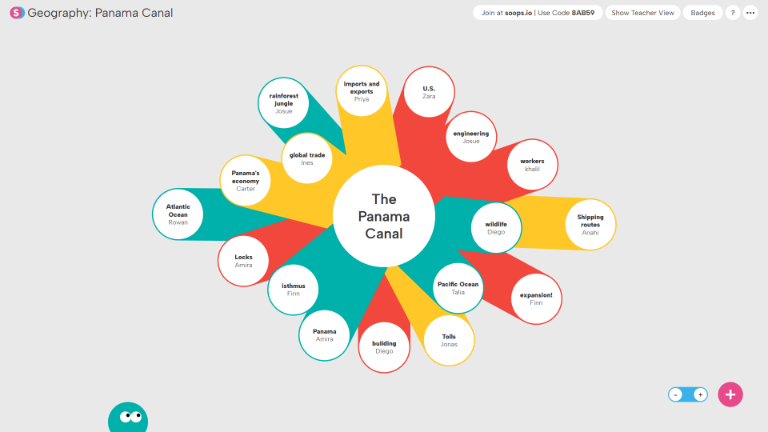
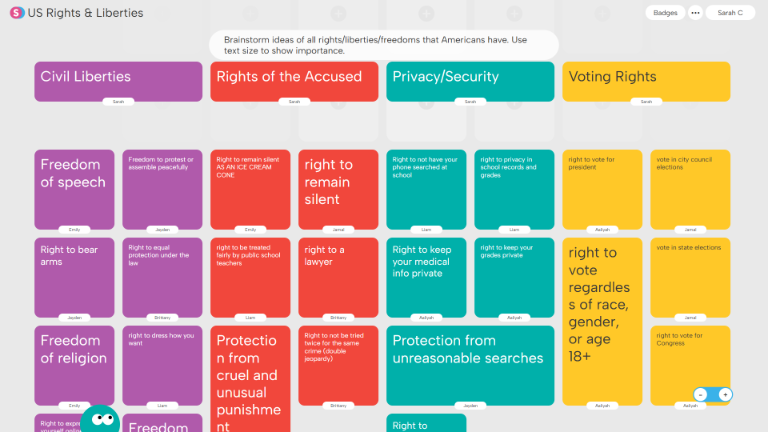
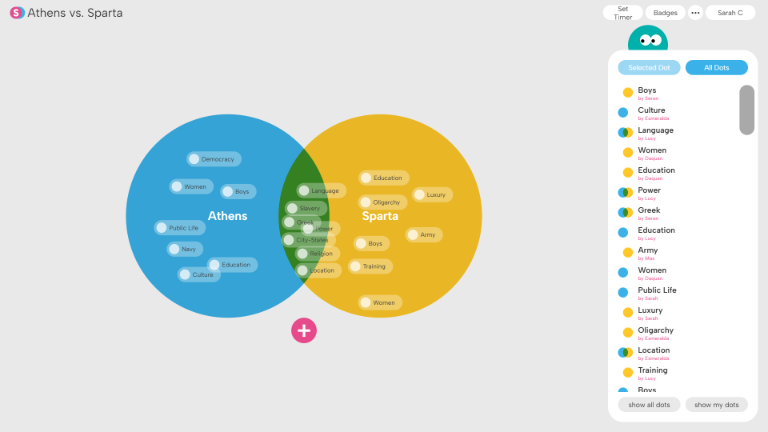
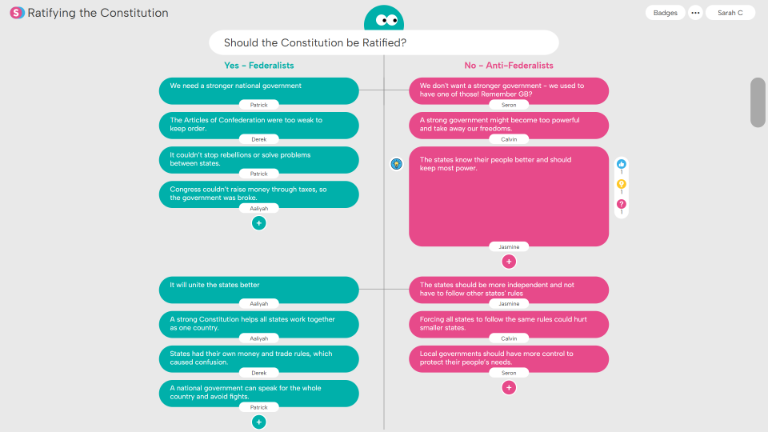
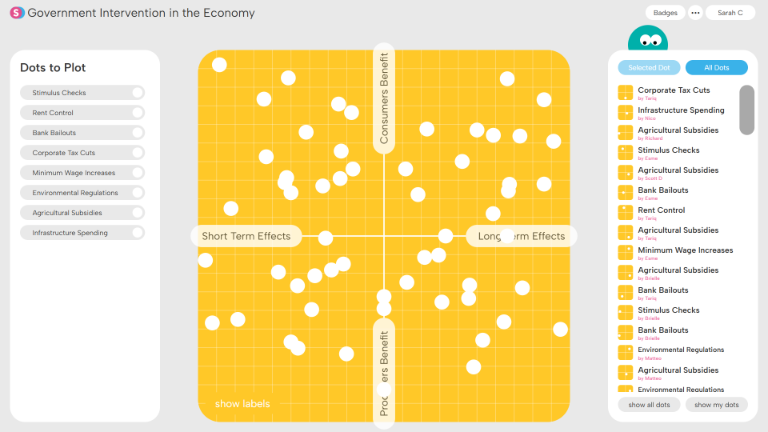
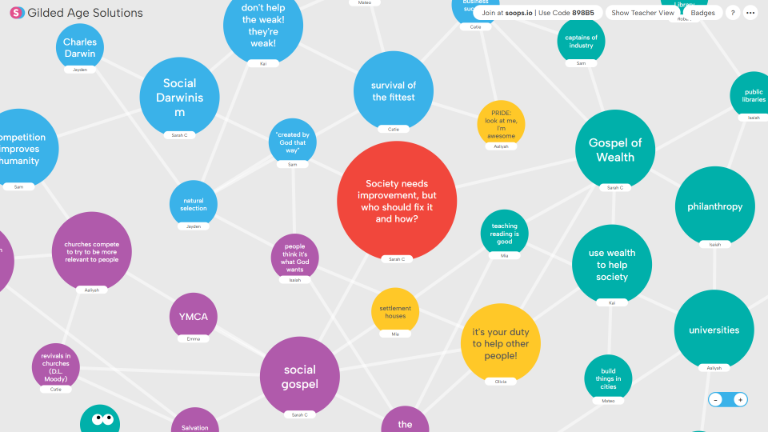
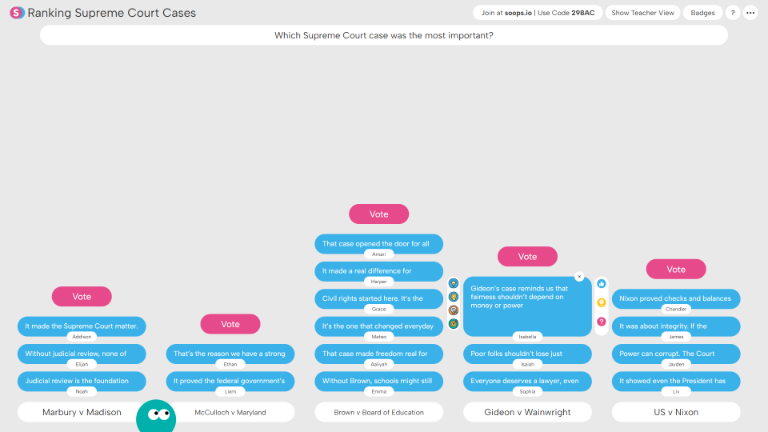
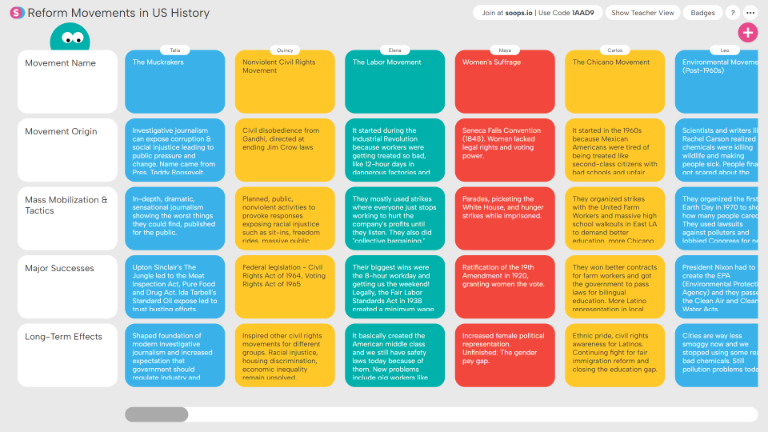
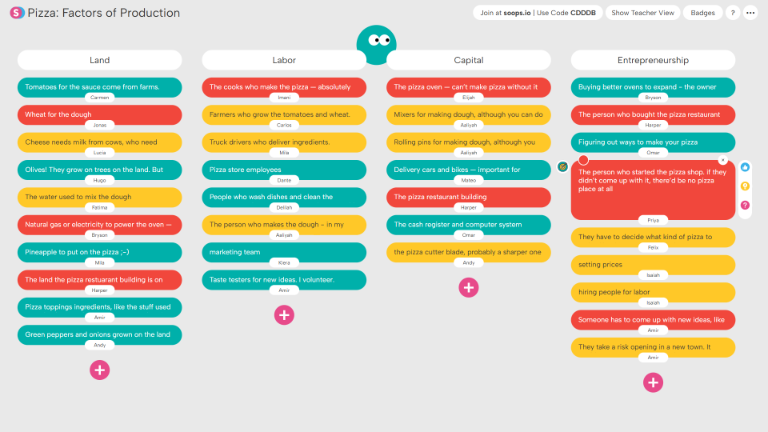
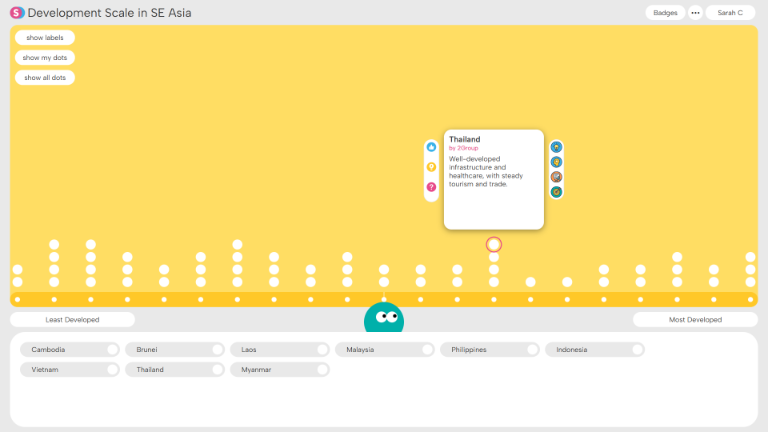
Colorful mind map displaying key concepts and names related to the Panama Canal, including geography, economy, trade, engineering, and wildlife.Digital brainstorming board titled 'US Rights & Liberties' with columns for Civil Liberties, Rights of the Accused, Privacy/Security, and Voting Rights, containing user-submitted ideas written in colored text boxes.Venn diagram comparing Athens and Sparta with circles showing unique and shared traits like democracy for Athens, oligarchy for Sparta, and shared traits such as language and religion.Diagram comparing Federalists and Anti-Federalists arguments on constitution ratification, with points for strong national government on left and state power on right.Scatter plot showing government interventions in the economy with dots representing different policies clustered by short vs long term effects and consumer vs producer benefit on yellow grid background.Colorful concept map exploring societal improvement topics including Social Darwinism, Gospel of Wealth, social gospel, philanthropy, and their interconnections.Interactive ranking chart titled 'Ranking Supreme Court Cases' showing user votes and comments for various landmark cases including Marbury v Madison, McCulloch v Maryland, Brown v Board of Education, Gideon v Wainwright, and US v Nixon.Table titled 'Reform Movements in US History' with columns for The Muckrakers, Nonviolent Civil Rights, The Labor Movement, Women's Suffrage, The Chicano Movement, Environmental Movement, listing movement origin, mass mobilization, major successes, and long-term effects.Diagram titled 'Pizza: Factors of Production' with four columns labeled Land, Labor, Capital, and Entrepreneurship, each containing colorful sticky notes describing relevant factors like ingredients, workers, equipment, and business decisions involved in making pizza.Interactive development scale chart for Southeast Asia countries showing Thailand labeled as well-developed with infrastructure, healthcare, tourism, and trade towards the middle-high development range.

Full Lesson Plans (List of Buttons)

Save time with our complete lesson plan PDFs. Each guide includes a ready-to-use Superstructure and detailed teaching strategies.

Lesson Plan Collection

While many teachers create their own Superstructures, we also offer full lesson plans addressing common topics. Each plan includes clear classroom guidance along with up to 6 ready-to-use Superstructures to choose from.

Full Lesson Plans (Tabs Sorting)

Save time with our complete lesson plan PDFs. Each guide includes a ready-to-use Superstructure and detailed teaching strategies.

Students use the "I Notice, I Wonder I Guess" framework to move from concrete observation to historical interpretation as they analyze the 1917 "Exploding in His Hands" Zimmerman cartoon - or any cartoon of your choice.

Students organize and discuss everything they know about a cartoon's context: creator, publication, audience, and political moment. Use with Nast's "To the Victor Belong the Spoils" - or any cartoon of your choice.

Students identify and decode key symbols, characters, and compositional choices within the 1900 Puck cartoon "The Real Trouble Will Come with the 'Wake'" - or any cartoon of your choice.

Six structures for studying the Progressive Era including Four Goals of Progressivism, Muckrakers & Progressive Reform, Evaluating the Square Deal, Comparing Progressive Presidents, Debating Early Civil Rights Strategies, and an Overview/Review.

Six structures for studying the Roaring 20s including an Overview, Return to Normalcy, African-American Experiences, Economic Boom & Bust, Life Changers of the 1920s, and Tradition vs. Modernity.

Six structures on the Great Depression and New Deal including Human Experiences of the Depression, Hoover vs. FDR's First Hundred Days, The Three R's, New Deal Success Score, FDR's New Deal — Necessary Action or Dangerous Precedent?, and The New Deal: Too Far or Not Far Enough?

Six structures for World War 1 in US History including The Main Cause of US Entry, The Difference-Maker in WW1, The US Home Front in WW1, Wartime Speech & Security, The Peace after WW1, and Legacies of World War 1.

Six structures for World War 2 in US History including an Overview of World War 2, From Neutrality to War, The Arsenal of Democracy, Wartime Discrimination, The Decision to Use the Atomic Bomb, and Consequences of World War 2.

Students trace major reform movements across US History while identifying patterns, analyzing strategies, and evaluating long-term impact.

Social Studies Structures by Topic

Click a topic below to open Soop’s Structure Starter and explore 18 AI-generated Superstructures related to that topic.

Create a Superstructure Today!